I’m Robert Rothkopf – I’m the Managing Partner of Balance Legal Capital.
At Balance we predict litigation outcomes and invest capital if we expect a case to win.
As anyone who has been involved in litigation will know, that’s rarely an easy prediction to make.
We’ve spent time at Balance thinking about how to improve our litigation forecasting accuracy – taking lessons from the world of behavioural economics to reduce cognitive bias in our investment decisions.
We call it Litigation Superforecasting inspired by a book called Superforecasting by Philip Tetlock. In the next couple of minutes, I’m going to share three techniques that we use at Balance to improve our forecasting accuracy.
The first habit we’ve adopted is to ditch phrases like “strong prospects” and “good chance” – phrases that you often see in legal advice – and instead we “put a number on it”.
Our research has shown that these phrases mean different things to different people – one lawyer might use the phrase “good chance” to mean a 45% likelihood, while another person reading that advice might interpret the phrase as 60%.
When we communicate our confidence levels in a case, amongst the team and other people, we use percentage numbers to reduce miscommunication.
The second technique is to “harness the anchoring effect”. This is the cognitive bias that we are all susceptible to whereby our estimates and our feelings about something are skewed heavily by the first piece of data we receive or the loudest voice in the room.
In litigation forecasting, this means resisting as far as you can becoming seduced by large claim values, the drama of the story, and try to block out other people’s views on a case before you’ve heard the facts and evidence and come to your own view independently.
It also means taking a step back and considering the “base rate”. For example:
The behavioural economist Daniel Kahneman has shown that if you anchor yourself in the “base rate” first and then dive into the specifics, your estimates and predictions are more accurate.
Moreover – the more independent views you can integrate, the better. No one person has all the relevant information to make a good forecast. At Balance, we capture and combine the individual views of our team of experienced litigators – and where possible augment that with outside input from our network of experts. This method amplifies our forecasting accuracy.
The over-arching question we are trying to answer is: “will our client’s case win and make a worthwhile recovery?”
That’s a difficult unknowable question. So, technique no 3 is to break up the unknowable question into smaller knowable parts. For example:
The further you break your analysis down into knowable components before jumping to your answer, the better your litigation forecast will be.
We’re delighted to once again see Balance and members of our team recognised in Chambers and Partners Litigation Support 2026, with top-tier rankings in both the UK and Australia.
Balance Legal Capital is delighted to support the Commercial Litigators’ Forum (CLF) once again as a Gold Sponsor.
CLF brings together leading litigators to share insights, foster collaboration, and champion access to justice. Through our support of the CLF, we are proud to support the important work of the National Pro Bono Centre and the wider pro bono community.
Simon’s session explored the role of litigation funding in class actions, particularly from an insurance perspective, where there is still more to be understood around how funding works and the different structures available.
An important and evolving area as the market continues to mature.
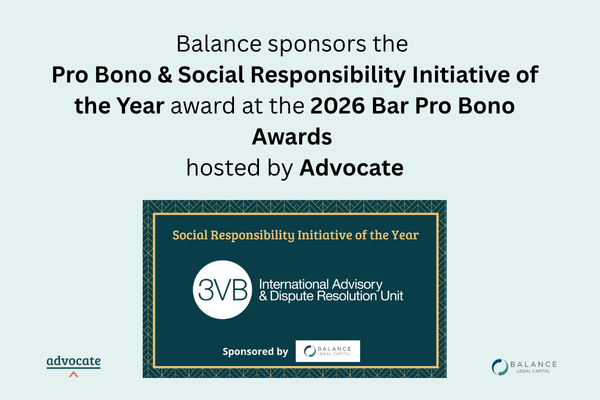
Balance were once again honoured to sponsor the Pro Bono and Social Responsibility Award at this year’s Bar Pro Bono Awards, organised by Advocate. It was a fantastic evening recognising the impact of pro bono work across the Bar. The award was skilfully presented by Sarah Abram KC.


.jpg)

Balance is a member of the Association of Litigation Funders of England & Wales. Our membership of the ALF requires us to satisfy on an ongoing basis stringent financial and capital adequacy tests and to comply with the ALF Code of Conduct.
Balance is a founding member of the Association of Litigation Funders of Australia, and a member of ILFA, the International Legal Finance Association.
Balance Legal Capital LLP is authorised and regulated by the UK’s Financial Conduct Authority.
.png)

%20(1).png)
.png)