Litigation finance is a financial product with wide-ranging applications. Its most obvious benefits are for impecunious claimants who would otherwise be unable to pursue a legitimate claim. However, litigation finance can also benefit companies that have traditionally used their own balance sheets to fund litigation. Below is a summary of the key benefits of litigation finance that should be considered by in-house counsel (in consultation with financial controllers) when deciding whether to pursue a claim, and if so, how to finance it. Companies that routinely conduct this analysis will be better-equipped to appreciate the financial implications of litigation and manage their legal budgets.
Litigation finance allows companies to pursue valuable claims without using their own capital, freeing resources to support their operations and growth. Most third party litigation finance is non-recourse, meaning that the company will not have to pay it back if the claim is lost. Backed by funding, companies can enforce legal rights that they otherwise might not have had the resources to pursue.
Securing litigation finance enables an individual or company to level the playing field against better-resourced opponents. It can ensure that a claimant is able to retain lawyers of the right quality and expertise, and to pursue a better case strategy. The very involvement of a litigation financier in a case can, from early on in proceedings, be a catalyst for the resolution of a claim, encouraging mediation or settlement discussions. It signals to a defendant who might be pursuing a strategy to prolong litigation and drain the claimant’s funds that such tactics will not succeed and that the funded claimant can, if necessary, pursue the case to adjudication. Funding therefore neutralises any ‘bullying’ tactics by bigger opponents by reducing or eliminating resource inequality.
The moment a claimant decides to pursue litigation they are taking on financial risk. That risk, which derives from the fact that even the most seemingly meritorious claims can fail, encompasses not only the irrecoverable ongoing costs of the litigation – lawyers’ fees, disbursements etc. – but also the risk that if the case is unsuccessful, it be ordered to pay the other side’s costs. Litigation finance can shift that financial risk to a third party financier, who has significant expertise in litigation and carries a diversified portfolio of case investments. This makes them better able to bear the risk than a claimant pursing a single claim (or small number of claims).
A litigation claim is a contingent asset. Litigation finance is a form of non-recourse borrowing secured by this asset. Claimants with valuable claims can use litigation finance to unlock the value of those claims prior to final adjudication. In most instances, litigation finance is sought to pay legal fees and expenses. However, litigation finance may also be advanced directly to the company to support their operations whilst the legal claim is in train. This is particularly beneficial in the case of growth companies who face high borrowing costs and limited access to capital markets.
The costs of litigation are subjected to a double dose of unfavourable accounting treatment. First the costs and expenses of litigation, which are usually incurred monthly, are expensed through a company’s profit and loss statement, reducing its operating earnings. Second, if the company ultimately makes a recovery on its claim, the income is recorded as ‘below the line’, non-operating income because it is a one-off item not generated by the company’s core business. As a result, litigation weakens a claimant’s financial statements. Claimants can use litigation finance arrangements, under which a third party assumes the financial risk of litigation, to eliminate the prejudicial effects of litigation on their financial statements.
The team at Balance Legal Capital are former litigators who have themselves assessed and run cases, and have broad knowledge of the legal services market. In order to fund a case, a funder has to assess the case as a whole by carrying out a due diligence process which looks at a range of key factors including: merits, quantum (losses being claimed), case strategy, enforceability of any judgment or award, potential for settlement, costs, budget and any requirements for funding or insurance for adverse costs. If the third party financier decides to finance the case then the claimant (and its opponent) can interpret this as a signal that an independent party also considers the merits of the case to be strong, and is willing to ‘put its money where its mouth is’. Even if a third party financier decides not to invest, the claimant and his lawyers are likely to gain valuable insights into the weaknesses of the case and matters that they should address. Either way, the case benefits from an independent review of the case, strategy and budget.
Once invested in a case, the interests of the claimant and the litigation financier are aligned in that they have a common interest in ensuring that the appropriate team, fee structure (including contingent fee arrangements) and case strategy are in place and that budgets are met. Where a claimant needs to exert its influence over case strategy and budget, a third party funder can be a valuable ally in raising these issues with the claimant’s legal team.
Balance Legal Capital is delighted to support the Commercial Litigators’ Forum (CLF) once again as a Gold Sponsor.
CLF brings together leading litigators to share insights, foster collaboration, and champion access to justice. Through our support of the CLF, we are proud to support the important work of the National Pro Bono Centre and the wider pro bono community.
Simon’s session explored the role of litigation funding in class actions, particularly from an insurance perspective, where there is still more to be understood around how funding works and the different structures available.
An important and evolving area as the market continues to mature.
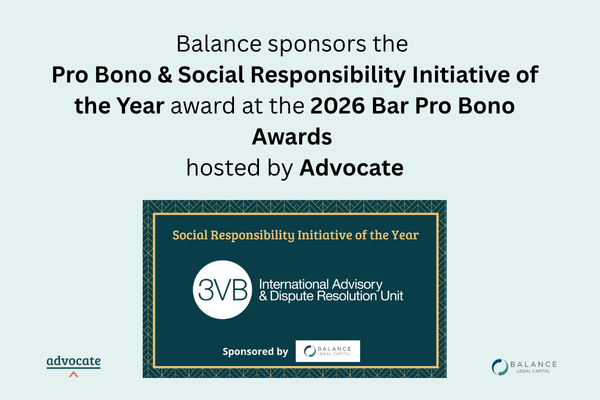
Balance were once again honoured to sponsor the Pro Bono and Social Responsibility Award at this year’s Bar Pro Bono Awards, organised by Advocate. It was a fantastic evening recognising the impact of pro bono work across the Bar. The award was skilfully presented by Sarah Abram KC.


.jpg)

Balance is a member of the Association of Litigation Funders of England & Wales. Our membership of the ALF requires us to satisfy on an ongoing basis stringent financial and capital adequacy tests and to comply with the ALF Code of Conduct.
Balance is a founding member of the Association of Litigation Funders of Australia, and a member of ILFA, the International Legal Finance Association.
Balance Legal Capital LLP is authorised and regulated by the UK’s Financial Conduct Authority.
.png)

.png)