Robert Rothkopf speaks about allocation of third party funding costs in international arbitration at ICC YAF Conference in Zurich on 30 June 2017.
On 30 June 2017, Robert Rothkopf spoke at an ICC international arbitration conference in Zurich, hosted by Wenger & Vieli AG, that focused on cost allocation in international arbitration and its interplay with third party funding.
Robert’s presentation covered the recent case of Essar v Norscott in the UK which confirmed that arbitrators have the power to allocate third party funding costs to the losing party (namely, the premium or success fee payable by a funded party to a funder).
Robert provided Balance Legal Capital’s view that cost allocation decisions should be primarily driven by a consideration of party conduct during the dispute and the “English Rule” that costs should follow the event – “Arbitrators should use their cost allocation powers to penalise dilatory or bad faith conduct which ultimately drives up costs and slows down the arbitration process.”
Robert also outlined (i) the extent to which disclosure of funding should be made to opponents and tribunals; (ii) the fact that tribunals lack the jurisdiction to make costs orders against third party funders as they are not a party to the arbitration agreement; and (iii) the difficulties with defining a “third party funder” given that it is essentially a provider of corporate finance, the way a bank might loan to a company whose main asset is a litigation claim. Security for costs was briefly considered and it was acknowledged that the mere presence of third party funding was insufficient to form the basis for a security for costs order against a claimant, the real test being that the respondent would have to show that there had been a material change of circumstances of the claimant since the arbitration agreement had first been entered into.

Back in November 2015, we posted an article on the new Financial List in the UK High Court. Since then it has been confirmed by Mr. Justice Blair that the Financial List is “operating well” and the List appears to have proved popular, with at least eight new cases commenced there and two that have been transferred, covering a wide range of financial transactions (see speech by Mr Justice Blair in the Institute of Commercial and Corporate Law annual lecture).
Two cases have now reached trial in the List, including a case relating to the terms of a surety bonds facility which was transferred to the List at the request of the parties, in part due to the significance to the markets of issues regarding the interpretation of Loan Market Association documentation (see GSO Credit – A Partners LP & Ors v Barclays Bank plc v HCC International Insurance Company plc [2016] ECHW 146).
Perhaps more interestingly, a decision has recently been handed down regarding a contested application to transfer proceedings to the List. In Property Alliance Group Limited v Royal Bank of Scotland plc [2016] EWHC 207 (Ch), the significance of the subject-matter to the markets and to other cases involving similar issues (in particular, allegations concerning swaps misselling and LIBOR rate fixing), and assurances from the defendant that the trial date would not be disrupted, persuaded the Court to grant the defendant’s transfer application, despite the fact that this meant replacing the assigned judge after 15 months and that the claim was for c.£29m in damages (well below the £50m minimum in the criteria for the Financial List).
We make no comment on the merits of the transfer application in the PAG case or the motivations of the defendant for bringing the application. However, as investors in financial services disputes, we are interested to see the extent to which transfer applications could be used as a tactical tool for litigants in (existing) proceedings which meet the criteria for the List. Contested transfer applications are likely to be rare but there could be more cases where one party is unhappy with the incumbent judge and wishes to take their chances with a new assigned judge on the List and the other party prefers to maintain the status quo. The PAG decision provides useful guidance regarding whether the Court will be able to grant the transfer in such matters.
We’re delighted to once again see Balance and members of our team recognised in Chambers and Partners Litigation Support 2026, with top-tier rankings in both the UK and Australia.
Balance Legal Capital is delighted to support the Commercial Litigators’ Forum (CLF) once again as a Gold Sponsor.
CLF brings together leading litigators to share insights, foster collaboration, and champion access to justice. Through our support of the CLF, we are proud to support the important work of the National Pro Bono Centre and the wider pro bono community.
Simon’s session explored the role of litigation funding in class actions, particularly from an insurance perspective, where there is still more to be understood around how funding works and the different structures available.
An important and evolving area as the market continues to mature.
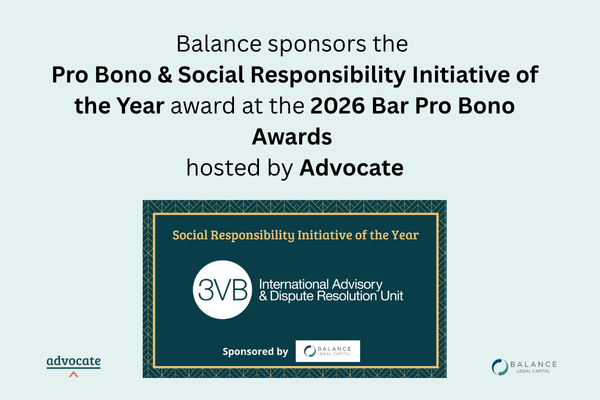
Balance were once again honoured to sponsor the Pro Bono and Social Responsibility Award at this year’s Bar Pro Bono Awards, organised by Advocate. It was a fantastic evening recognising the impact of pro bono work across the Bar. The award was skilfully presented by Sarah Abram KC.


.jpg)

Balance is a member of the Association of Litigation Funders of England & Wales. Our membership of the ALF requires us to satisfy on an ongoing basis stringent financial and capital adequacy tests and to comply with the ALF Code of Conduct.
Balance is a founding member of the Association of Litigation Funders of Australia, and a member of ILFA, the International Legal Finance Association.
Balance Legal Capital LLP is authorised and regulated by the UK’s Financial Conduct Authority.
.png)

%20(1).png)
.png)