‘Representative’, ‘class’ or “group” actions allow collective redress in civil litigation in England & Wales, Australia and the United States. However, there are critical differences between the rules that govern such actions in these jurisdictions, not only in relation to the procedural hurdles but also regarding the role of litigation funding.

‘Representative’, ‘class’ or ‘group’ actions allow collective redress in civil litigation in England & Wales, Australia and the United States. However, there are critical differences between the rules that govern such actions in these jurisdictions, not only in relation to the procedural hurdles but also regarding the role of litigation funding.
We have highlighted the key distinctions in the table below, but start with some general points:
The team at Balance Legal Capital has considerable experience in relation to international class actions and issues that commonly arise in funding these proceedings. Please feel free to get in touch if you would like to discuss this further.

We’re delighted to once again see Balance and members of our team recognised in Chambers and Partners Litigation Support 2026, with top-tier rankings in both the UK and Australia.
Balance Legal Capital is delighted to support the Commercial Litigators’ Forum (CLF) once again as a Gold Sponsor.
CLF brings together leading litigators to share insights, foster collaboration, and champion access to justice. Through our support of the CLF, we are proud to support the important work of the National Pro Bono Centre and the wider pro bono community.
Simon’s session explored the role of litigation funding in class actions, particularly from an insurance perspective, where there is still more to be understood around how funding works and the different structures available.
An important and evolving area as the market continues to mature.
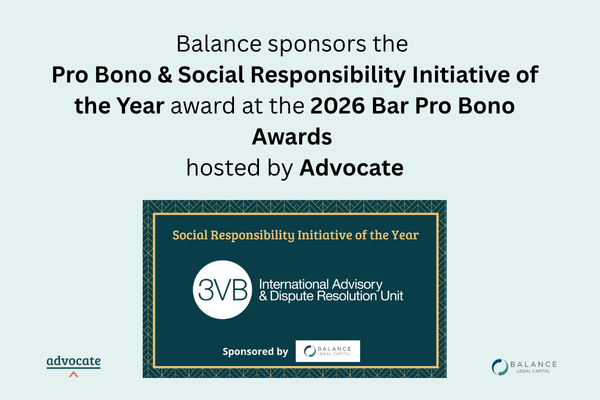
Balance were once again honoured to sponsor the Pro Bono and Social Responsibility Award at this year’s Bar Pro Bono Awards, organised by Advocate. It was a fantastic evening recognising the impact of pro bono work across the Bar. The award was skilfully presented by Sarah Abram KC.


.jpg)

Balance is a member of the Association of Litigation Funders of England & Wales. Our membership of the ALF requires us to satisfy on an ongoing basis stringent financial and capital adequacy tests and to comply with the ALF Code of Conduct.
Balance is a founding member of the Association of Litigation Funders of Australia, and a member of ILFA, the International Legal Finance Association.
Balance Legal Capital LLP is authorised and regulated by the UK’s Financial Conduct Authority.
.png)

%20(1).png)
.png)